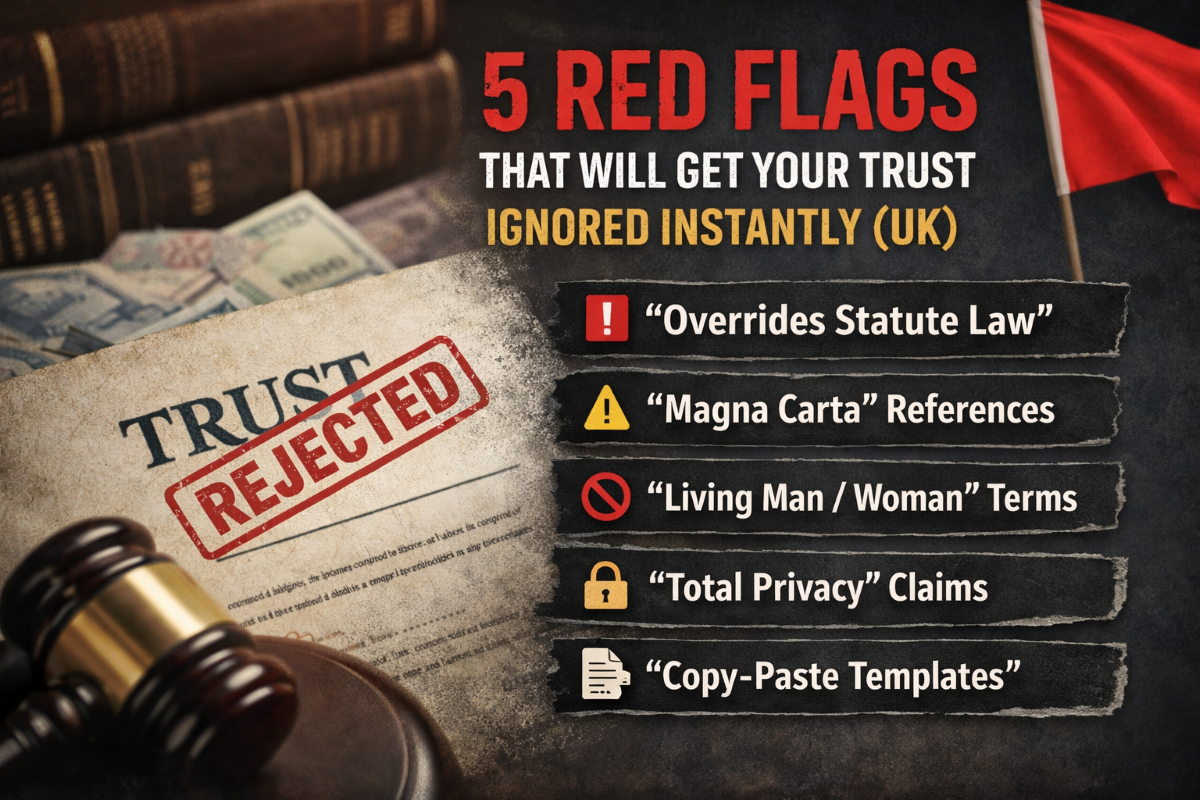
5 Red Flags That Will Get Your Trust Ignored Instantly (UK)
Over the past five years, I’ve been deep in the world of private trusts, asset protection, and alternative approaches to ownership.
I’ll be honest, I got caught up in parts of the “sovereign” movement along the way. Some of the ideas sound compelling. Some even appear to make sense on the surface.
But as I’ve continued learning, working with professionals, and seeing what actually happens in practice, one thing has become very clear:
If your trust isn’t recognised, it doesn’t work.
This post is about putting things right, not just for myself, but for anyone else who’s been heading down the same path.
I’d rather be accurate than popular, and sometimes that means correcting course.
Some of what I previously aligned with, I no longer stand by.
🚩 Red Flag 1: Trying to Override Statutory Law
If your trust says anything along the lines of:
- “This trust operates outside statutory law”
- “Equity overrides all legal systems”
- “This trust is governed solely by private jurisdiction”
- “This trust is governed by Natural/Universal/God Law”
You’ve got a problem.
In the UK, trusts operate within the legal system, not outside it. Your right to exclusive use and control of property is recognised and enforced by the legal system. You cannot own property and be outside of the system. See our earlier post: https://privatetrusts.direct/you-can-step-outside-the-system-but-your-assets-cant/
Equity and statute work together. One does not cancel out the other.
If your document tries to sidestep statute entirely, it will not be taken seriously by:
- courts
- banks
- HMRC
- or the Land Registry
And these are the bodies we need to recognise our asset protection mechanisms.
🚩 Red Flag 2: Dropping in Historic Acts Like Confetti
Magna Carta.
Bill of Rights.
Act of Settlement.
If your trust reads like a history lesson, it’s likely to raise eyebrows.
These are often included to make documents sound authoritative.
But unless they are directly relevant, they add no legal strength whatsoever.
In fact, they tend to signal the opposite.
🚩 Red Flag 3: “Living Man / Woman” Language
This is one of the biggest tells.
Phrases like:
- “living man”
- “living woman”
- “flesh and blood” distinctions
…have no recognised legal effect in UK trust law.
Including them does not strengthen your position.
It weakens your credibility instantly.
🚩 Red Flag 4: Claiming Total Privacy and Non-Disclosure
Yes, trusts can offer privacy.
No, they are not invisible.
If your structure suggests:
- no reporting obligations
- no interaction with institutions
- complete separation from regulatory systems
…it’s unrealistic.
You still need:
- bank accounts
- compliance checks
- legal recognition
Without those, your trust cannot function in the real world. Yes, there is the curtain principle, but it doesn’t work the way that you are lead to believe.
🚩 Red Flag 5: Templates That Sound Powerful but Don’t Work
This is a big one.
There are a lot of templates circulating that:
- look impressive
- use complex language
- reference lots of “legal” concepts
But when tested in practice?
They fail.
Documents get:
- rejected
- ignored
- or challenged
And the person relying on them is left exposed. And so are their assets.
So What’s Changed?
As I’ve developed my understanding of how the legal system actually works, I’ve had to take a step back and reassess.
Some of what I previously aligned with, I no longer stand by.
Not because the intention was wrong, but because the application was.
At PrivateTrusts.education, we don’t draft trusts, we educate.
And with that comes responsibility.
So we are now removing all sovereign-style language from our education and materials.
That includes:
- jurisdiction clauses that attempt to override the legal system
- pseudo-legal terminology
- anything that risks a trust not being recognised
The Bottom Line
If your trust:
- can’t be understood by a solicitor
- can’t be accepted by a bank
- or wouldn’t stand up in court
…it isn’t protecting you.
It’s putting your assets at risk.
Moving Forward
This isn’t about abandoning the idea of private trusts.
It’s about doing them properly.
Understanding how the system works.
Working within it intelligently.
And building structures that actually hold up when it matters.
Being a will drafter is incredibly challenging – the system is very complex and it’s very easy to give bad advice. It’s so important to ensure the person helping you is actually helping you rather than telling people what they want to hear rather than what actually works.
Not here, I take my work seriously and responsibly.
Final Thought
I’d rather teach something that works in the real world,
than something that just sounds good on paper.
If you’ve been exploring this space and something hasn’t quite sat right, trust that instinct.
You’re not wrong.
You’re just ready for a better approach.
If you need help updating your documentation to ensure it is recognised and enforceable, please reach out.
If you want to switch to a lawyer drafted trust, we will do it at cost.








Post Comment